The Erb Memorial Union is filled to the brim with excellent art pieces. Whether it’s the Taylor Lounge’s abstract work by Nelson E. Sandgren, Marta Ramirez-Oropeza’s large mural depicting the history of the Chicano movement on the large green marble stairs, or the ever-rotating art featured in the Adell McMillian Gallery, one needn’t look far for interesting paintings.
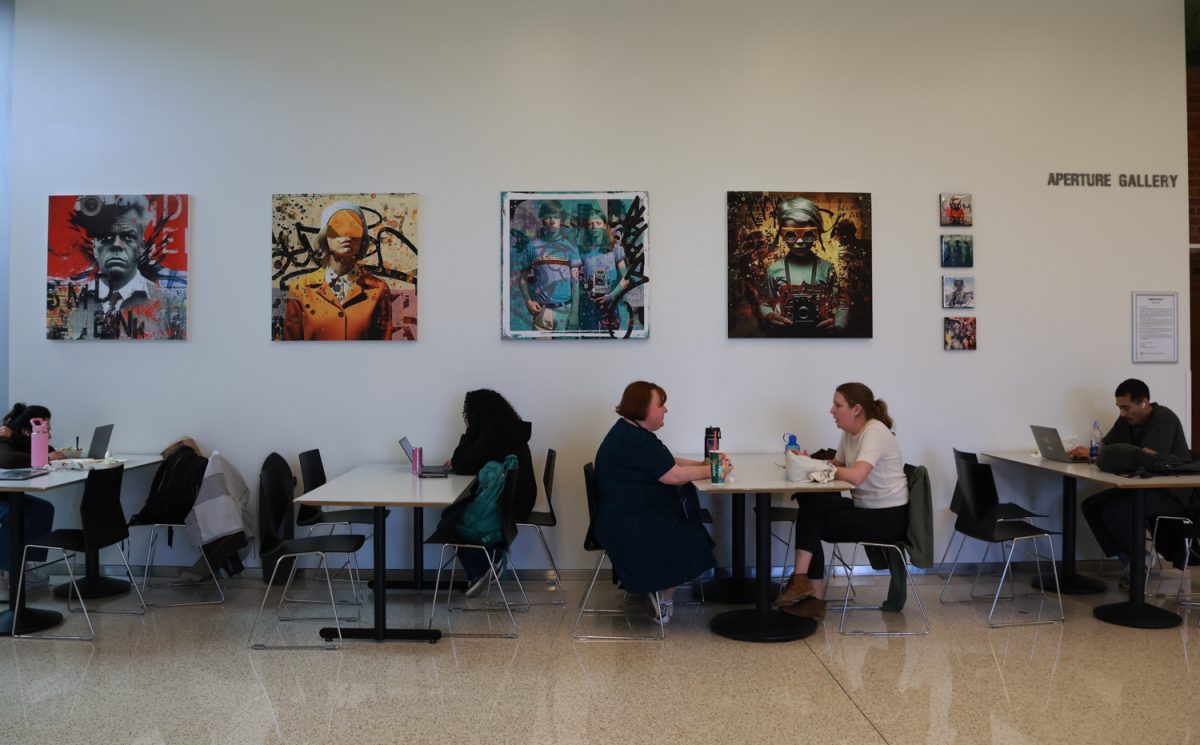
The “Aperture Gallery,” the wall opposite the U.S. Bank, sees its art pieces cycled out every quarter. Winter quarter, the wall features the work of photographer, graffiti artist, painter, and artificial intelligence proponent Walter Portz. Each of the eight pieces displayed contains a central image generated with AI, which has led to criticism in the form of retaliatory art pieces and notes stuck to the wall describing the pieces as “lazy” and “AI B.S.” While it is presently unknown what individuals are leaving their notes of descent, other artists at the University of Oregon are similarly upset.
“I find the university promoting this use of AI to be incredibly disheartening and disappointing,” Art Ducko artist Seth Avila said. “I feel like, of all places, a university should be encouraging people to put in the work to do things, especially when it comes to artwork.”
Though the Aperture Gallery is overseen by the Center for Student Involvement, Craft Center director Jennifer Salzman is largely in charge of selecting the art. When the artist initially intended to exhibit their work dropped out three weeks before winter quarter, Salzman reached out to Portz, with whom she previously attended the University of Minnesota.
“Walter did us a favor by stepping in,” Salzman said. “I told him he could show whatever he wanted. When Walter showed me this stuff, I was like ‘okay, not exactly what I had envisioned’, but I was very excited to put it up.”
Portz’s pieces are composites of his photography, pictures of graffiti tags he took while traveling, and more. The central AI element was generated by feeding his own images into Midjourney, a popular AI generation program. Originally, the viewer was supposed to scan a QR code that allowed the user to use their phone to see each individual layer of the work via augmented reality. The program, Adobe Aero, shut down shortly before the exhibit went up, after the pieces were already printed. While much of the work in the collage was created by Portz, the question of human authenticity still plagues the work.
“I’m not a fan of AI, I think it’s so removed from humanity,” August Reitan, former director and current artist for Art Ducko said. “ If they created that part, why couldn’t they have used their art to make the whole thing?”
Portz, having gotten involved with digital art programs like Adobe Photoshop before it was widely accepted by the art world, is well acquainted with criticism from artists. He’s found that wider audiences are typically more accepting of his work.
“As far as artists go, I got the same response in the 90s when I was doing collage art,” Portz said. “People were very critical and I kind of developed a thick skin. The general public f*cking loves the work. I’ve had elementary and high school art teachers ask me to come speak to their classes, because it’s a technology that’s not going away.”
AI-generated work has accrued a reputation for being displeasing to the eye, even ugly. In fact, “AI slop” is now a common phrase to identify AI-generated images. The aesthetic quality seems to be of less concern to Salzman than the artistic statement, and she views not featuring the art as censorship.
“Do they really want me to start censoring artwork on whether or not they think it’s ugly?,” Salzman said. “That’s a slippery slope. There’s nothing inappropriate with the content. There’s nothing inappropriate with Walter as a person. Those are the two criteria that I would be obligated to censor things. My job is not to hang art that everybody’s gonna like, my job is to hang art that is going to stimulate and create conversation.”
Of course, aesthetics are an important part of curation, a fact that Salzman recognizes in relation to long term exhibits.
“If I was curating for, say, the permanent collection, where something is going to hang indefinitely on a wall for the next five years—that might become a different conversation. This is a short term, 90-day moment in time, it’s gonna rotate out.”
The display is temporary, but the message it sends is lasting. AI-generated images are already prevalent at UO. Be it in lectures, in club posters, even as advertisements for the Adell McMillian Gallery, the persistence is impossible to deny. Portz’s pieces are seen by some as an extension of the growing prevalence of AI images.
“It definitely goes to show the normalization of the usage of generative AI, specifically because generative AI has been seeping into classrooms,” Art Ducko artist Mona Nazandarani said. “AI expanding to the hallways, with the [the university’s] full awareness of it, goes to show that they are beginning to normalize it. It’s really starting to consume social norms quite a bit.”
Ultimately, both Salzman and Portz take the response as a net positive.
“As an artist myself, I always say any reaction is a good reaction. Even if somebody is upset that we decided to hang this work, it’s creating dialogue,” Salzman said, “ It’s getting the blood flowing.”
Portz similarly welcomes the criticism.
“Some of the students have been putting notes by it, which I’m actually totally good with,” Portz said. “I would love to sit with students and let them ask me questions and criticize me.”