


There is only one road in and out of Oakridge, a small town tucked deep in the Willamette National Forest. There is also only one newspaper — and it may not exist for much longer.
As news deserts expand across the country, Oakridge risks losing its only local publication just five years after its debut. “Interim editor” George Custer, a 15-year veteran of the Marine Corps and former smokejumper, who had no prior experience in journalism, is preparing to re-retire as uncertainty hangs over the future of the paper.
The Highway 58 Herald formed in 2021, months after its predecessor, the Dead Mountain Echo, ceased publication after nearly 50 years. The Herald was founded by two-time Pulitzer Prize winner Doug Bates, who stepped away after eight months.
Custer, who took over the paper in 2022, returned to his home state of Oregon from California in 2007, alongside his wife, Sayre — who he said was hesitant at first to move to the town of about 3,000.
The two visited Oakridge on what he described as a “drizzly Christmas Day” to check out a property they had scouted.

“I knew within five minutes that she loved the place. That’s how it started,” he said.
Custer’s retirement didn’t last for long after arriving in Oakridge. He joined the city’s planning and economic development commissions as well as headed the Oakridge Uptown Business & Revitalization committee for nearly 10 years, in addition to extensive involvement in the American Legion.
When Bates stepped down from the Herald due to health reasons, he recommended pausing operations to raise money while searching for a new editor. For Custer, who had not partaken in journalism since high school, pausing wasn’t an option.
“I told Bates, I said, ‘No, we have to keep this thing going. I’ll take over,’” Custer said. “He put his hand on my shoulder and said, with a wry smile, ‘George, you have no idea what you’re getting into.’”
Describing himself as “Mr. Optimist,” Custer said he jumped in headfirst.
“For the longest period of time, a couple of years, if I was writing something, I would feel his hand on my shoulder, watching over me,” he said.
Years into what was supposed to be a temporary commitment, Custer said he maintained the title “interim editor” to remind himself that he was supposed to find a replacement and enjoy retirement.
Four years later, the “interim” title is finally coming to fruition as he prepares to re-retire March 15. He said he is stepping down for two reasons: a long-overdue promise to his wife that he would actually retire, and his belief that the paper will not last much longer.
“We’re running out of funds. We may not last a couple of months unless something breaks,” he said.
An emerging news desert
Oakridge is a small town — a single grocery store, fast food joints, a laundromat and small shops line Highway 58, the only road through town connecting Eugene to areas south of La Pine.
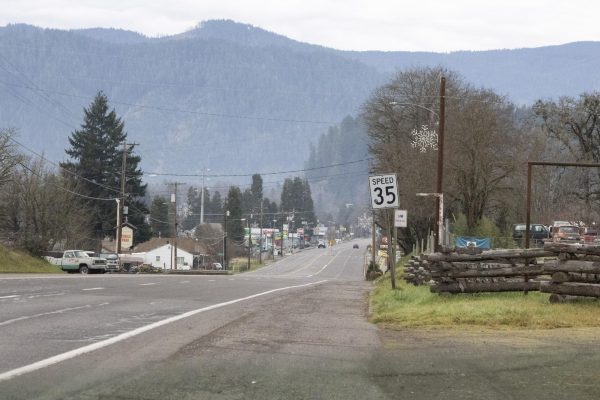
Older houses and trailers line the few streets in a town where nearly 24% of residents live below the poverty line — roughly double the statewide rate — and only about 34% of residents are employed, according to United States Census data.
But the town, framed by thick trees, snowcapped mountains and the winding Willamette River, was once a logging boomtown. The closure of three sawmills led to the loss of more than 1,500 jobs.
Now much of the town’s economy relies on its nationally acclaimed dirt biking paths and outdoor recreation activities.
Citing an average 2.5 newspapers closing each week in the U.S., Custer warns Oakridge is at risk of becoming Oregon’s latest news desert.
News deserts across the country are growing. In Oregon, there was a 20% decrease in the number of newspapers from 2004 to 2019, according to a study by the University of North Carolina’s Hussman School of Journalism and Media.
In 2025, The Seattle Times reported that three counties in Oregon were deemed news deserts.
“The reason the Herald started was the Dead Mountain Echo, which was the printed paper up here, had closed down about seven or eight months prior, and shenanigans started happening at city hall,” Custer said. “Most people didn’t know anything about that because there was no paper.”
The city faces several imminent issues, including the possible acquisition of TV Butte, a former broadcasting site just outside town believed to contain buried toxic waste from its lumber days, and a proposal to turn it into a gravel quarry that could risk contaminating the city’s water supply.

Custer said these issues will go unreported, allowing plans for the butte to advance without a platform for public awareness or scrutiny.
In 2025, the Agora Journalism Center at UO’s School of Journalism and Communication studied how residents of Oakridge accessed local news and civic information. The study found residents relied mostly on word of mouth and social media and encountered issues with outdated information due to the Herald’s “limited capacity.”
The study polled more than 100 Oakridge residents and found that many craved a physical print product and a live TV station.
In 2023, the Herald began printing physical papers in an effort to expand its presence and appeal to Oakridge’s majority 55-and-older population, which Custer said residents enjoyed. But between printing, distribution and other related costs, he said it ultimately became too much.
“We were really kind of cheating ourselves. Had we started off with a good-sized nest egg, we could have had some working capital. But when you’re flying by the seat of your pants, any expenditure just really hurts, and the paper was killing us,” he said. “Papers across the country are going online only. So we tried to reverse that trend and immediately ran into too many roadblocks.”
Staffing a rural paper
Custer arrives at the Herald office at 7 a.m. each morning, checking the inbox and preparing for the day. Despite thousands of hours of work over the years, he has never taken a paycheck — nor have many of the paper’s volunteers.
In November 2024, Custer hired UO double master’s student Ellie Graham, who has since graduated and is set to take over in March. Graham, who lives and operates out of Springfield, has “really impressed” Custer.
Over the years, the Herald has offered internship opportunities to more than a dozen SOJC students, giving them hands-on experience and opportunities to publish work while helping staff the paper.
“Establishing the relationship with the SOJC was probably the best thing that happened to the Herald,” Custer said.
Many of the students initially volunteered; however, Custer has since hired them as independent contractors and paid them. He also pays an office manager — costs he said add up to thousands of dollars in expenses each month.
In spring 2025, SOJC instructor Charlie Deitz partnered with the Herald on an experimental “audio magazine” course, sending more than a dozen students to report on issues ranging from TV Butte to wildfire preparedness.
“We were able to talk about issues that affect residents on a daily basis,” Deitz said. “The Herald gave us that jumping point.”
Even with collaborations with the SOJC, a limited local advertising pool and the loss of its print product have left advertising sales practically nonexistent, forcing Custer and the Herald to rely on grants and other inconsistent sources of revenue.
According to Custer, grantmakers are generally more inclined to support student opportunities by funding his student contractors, but grants for operational expenses are few and far between.
As much as the Herald has relied on student work, Custer says depending on full-time students to staff a newspaper can be difficult.
“I have lunch with Doug almost every month, and he told me straight up, ‘Don’t get too enthusiastic about these students. They’ve got a lot of book learning, but they don’t always know what it’s like to be a journalist in the real world,’” Custer said. “And I always say, the reason they call it news is because it’s now. I don’t need that story five weeks from now.”
Custer said Graham has been helpful in integrating deadlines, and that he is confident in her ability to take over. No matter the future of the paper, he said that Graham has promised “she’ll hang around to the end.”
The Herald’s board of directors, made up of seven members, met on Feb. 9 to discuss options for the newspaper going forward. Custer said the board agreed to continue operating the Herald for as long as possible.
The paper is currently aiming to raise $20,000 to stay afloat.
In a social media post, Camilla Mortensen, editor of the Eugene Weekly, SOJC journalism instructor and Herald board member, urged people to donate so Oakridge doesn’t become a news desert.
“There are actual news deserts in Oregon — please help Oakridge not join them,” the post said in part.
“The (newspapers) that are closing are in rural communities,” Custer said. “They’re hardest hit because they have nothing other than Facebook and Twitter and all that, and there’s no fact checking. So it’s not really a news platform.”
In January, the Herald launched a GoFundMe campaign seeking $5,000 to keep operations running — a fraction of what is needed. A month later, the campaign had raised just over $1,700. Despite this, Custer warns time is running out.
“As optimistic as I’ve been all these years, I think it’s going to be a little too much, a little too late,” Custer said.
Moving forward
Custer sat in a mostly bare, cold office, a screwdriver beside him after attempting to fix the heat earlier that day. In front of a humming space heater, he said he was ready to sell the building for good.
“We’re getting ready to do inventory here (in the office) and see what we can get rid of, that sort of thing, should things move forward,” Custer said.
Reflecting on the past four years, Custer said he has learned a lot, particularly about the limits of trying to run the operation alone.

“I learned a lot in hindsight, the fact that I was trying to do it all,” Custer said. “I was writing grants, trying to sell advertising, editing, publishing and doing some reporting. It just became too much.”
When asked if he had any regrets, Custer said he only has one.
“No, I’m proud of what we’ve done,” he said. “The only thing I regret is that we didn’t have sufficient funds early on.”
He pointed to other local startups, such as Lookout Eugene-Springfield, which launched with millions of dollars in startup funding — something that was never realistic for the Herald.
“We literally got together, took money out of our wallets and put things together,” Custer said. “We were able to move very quickly, but with a minimal amount of funding, and it just stayed that way. We’ve been on the edge financially forever, and that’s probably taken the biggest toll on me. My wife is aware of that, and that’s why she’s been pushing me — ‘you need to get out of this.’”
As for his second retirement, Custer said this one is for real. The newspaper may leave Oakridge, but he has no plan to.
“We’re not going anywhere,” he said. “This will be our last stop.”








Mathew Grant • Apr 10, 2026 at 11:08 pm
The highway 58 Herald should stay. Businesses, Civic organizations like the American legion and the chamber of commerce, facilities like the WAC, Oakridge has lost too much of its core goodness of late. People are too willing to give up and move on, Oakridge needs to stand and fight for its future, as well as retaining and expanding on core necessities.