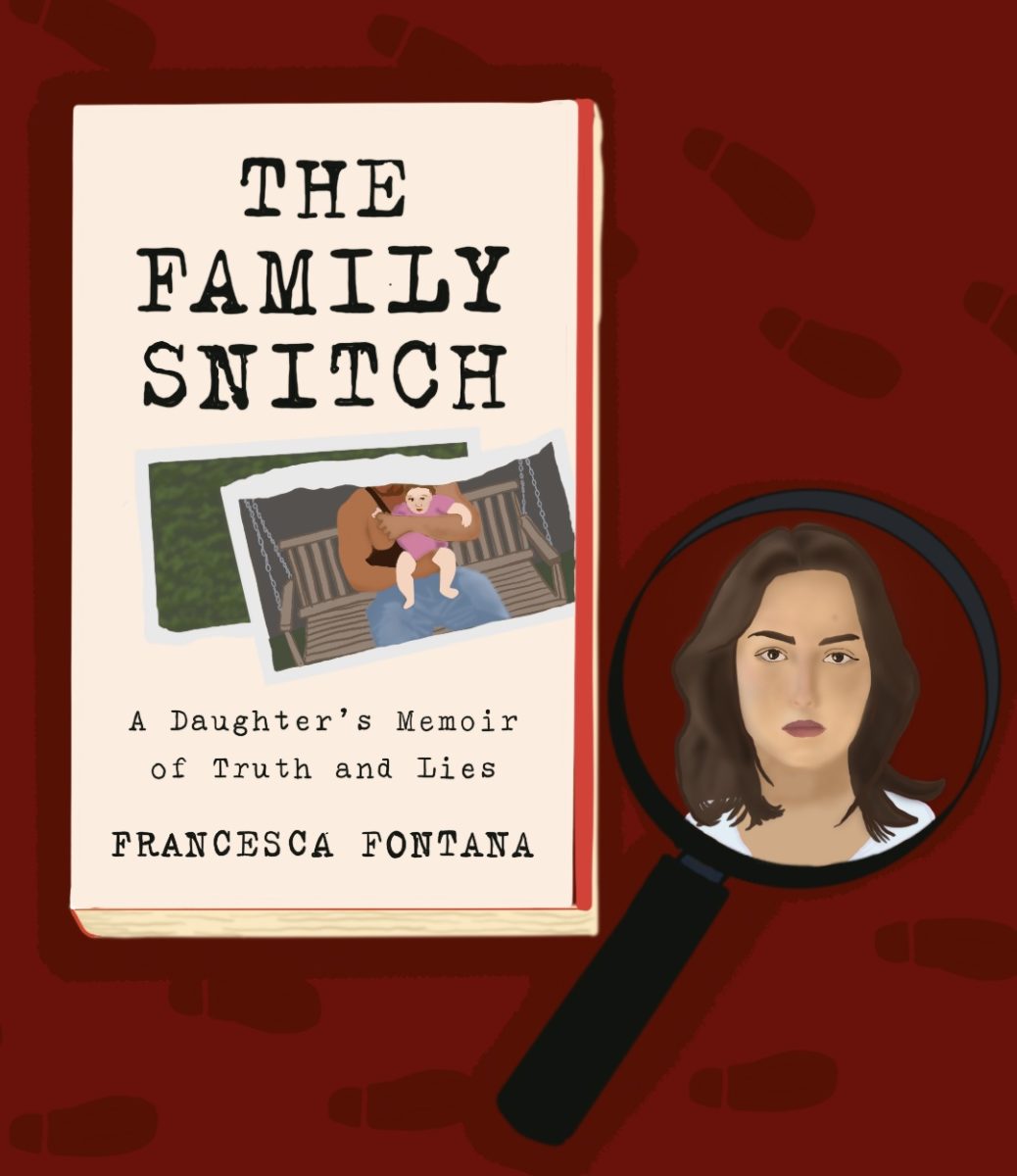
There’s an ongoing joke in journalism: if your dad says he loves you, you should check it out. Confirm the credibility of your source.
This was less a joke and more a mission statement for former Wall Street Journal reporter and UO SOJC alumna Francesca Fontana, who wrote an investigative memoir in pursuit of many truths, the ultimate one being: did her father love her?
“The Family Snitch: A Daughter’s Memoir of Truth and Lies” follows Fontana in search of an objective truth regarding her estranged father Al’s criminal past, focusing largely on USA v. Fontana, a 2001 case which resulted in Al’s imprisonment when Fontana was 9 years old.
The memoir, however, was the culmination of work which began after one particular Reporting II class.
It was 2015 and Brent Walth’s first term as a UO professor when Fontana visited his office. The visit came days after Walth showed Fontana’s class how to access federal court records for an upcoming project. The project required students to research Oregon politicians via public records, but Fontana had an alternative subject in mind: her father, with whom she was only “semi-estranged” at the time.
Fontana had years worth of questions concerning Al. Walth had access to a database which could provide some answers.
“I think that Brent and I both, during that day in his office, had the understanding that not only had something cracked open for me personally — the knowledge that I was going to be able to, you know — the truth that was there for me to find. That was obviously a no brainer that I would, I would go hunt all of that down,” Fontana said.
After years of not speaking to her father, Fontana called Al in Walth’s office that day. He offered to tell his daughter anything she wanted to know.
Fontana’s hunt for the truth of her father’s past became the basis of her thesis project, which she needed to produce to graduate from the Clark Honors College. Walth encouraged her to examine the nature of a memoir.
It was Halloween of 2016 when Fontana boarded a plane bound for Chicago, financed by a research grant, to interview attorneys, Chicago Tribune reporters and her family, all to comprehensively understand USA v. Fontana.
Then 22 years old, Fontana hadn’t seen Al since the summer after her junior year of high school, and the gravity of that reality dwarfed her fear of flying.
“I wasn’t really sure how I was going to keep my reporter persona — or not persona, my reporter self — and my daughter self separate,” Fontana said.
A glossy-eyed, father-daughter embrace and a reunion with her extensive Mexican-Italian family ensued. Fontana likened time with her extended family to “a shitty knockoff of ‘The Godfather’” in her book.
Al, for all his forthcomingness, proved to be the most challenging source. “He is very intelligent, and charming and equally deceitful,” Fontana said. She hoped Al’s deceit wouldn’t apply to her. It did, time and again as Fontana’s reporting would prove.
Fontana soon returned to Eugene in the wake of a Cubs World Series win and, in time, produced a book proposal and a handful of chapters as her thesis.
“I hoped that it would not be the end. I hoped — though maybe I wouldn’t have admitted it to anyone — I did hope at the time that this partial book proposal … would just be the jumping off point for me to write a full book proposal, and then hopefully sell the book,” Fontana said.
But it’s hard to propose and sell a debut book when the ending is unbeknownst to its author. “I wasn’t done living the events of what would become the book,” Fontana said.
A week after graduating from UO, Fontana moved to New York City and began interning for The Journal. A few months later, Fontana was at her newsroom desk when she received a text from Al: Eddie Hicks had been arrested.
Hicks was one of the five men involved in the fake drug raid which prompted USA v. Hicks et al. — the parent case which USA v. Fontana fell under. Instead of standing trial, Hicks fled and remained hidden for 14 years, causing the 2001 case involving Al to remain open, barring Fontana from accessing documents during her preliminary reporting work which might disprove — or scarier, validate — her father’s claims regarding his criminal history.
It was time for Fontana to resume her hunt for the truth, and maybe gain some closure.
Two years passed between Hicks’ arrest and his trial, but when the time came, Fontana — now a full-time reporter at The Journal — was there, vacation days be damned. A VHS tape was a key piece of evidence in both Hicks’ trial and Fontana’s trial of untruth against her father. When a TV monitor played the tape in court, both defendants were found guilty.
With Al’s approval, Fontana pitched an essay to The Journal weeks later, hoping it would be “a proof of concept, in a way” for a book. To her surprise, The Journal ran with the story.
Another trip to Chicago allowed Al the opportunity to respond to Fontana’s writing per The Journal’s “no surprises” policy, and for The Journal to capture portraits of Fontana and Al. Fontana recalled the portrait session to be the first time Al was punctual in his life. He talked to the photographer about ghosts, following Fontana’s confession to him that she didn’t believe his version of his story.
“After the 2019 story ran — I think it was like that Monday — I came into the office, and I had a couple voicemails; and it was two agents who had read the story over the weekend and thought, ‘Oh, wow, there’s a book here.’ So it actually was — it was almost too effective, the proof of concept,” Fontana said.
Although USA v. Hicks answered Fontana’s preliminary questions, she was not satisfied.
A new question emerged: “Does my father love me?” Another answer, the ultimate answer, Fontana hoped to discover in writing a memoir.
Fontana worked on a book proposal for three years, simultaneously unearthing parts of “The Family Snitch” which were already conceived or written. The bulk of the manuscript’s writing, however, was completed in a month-long push in 2024 when Fontana would return from work and do what she calls a “reverse Mr. Rogers” — a routine part of her writing process to ready herself for work, which includes donning a beige, linen apron with a red notebook in one pocket and pencils in another, ever the prepared craftsman.
Fontana ventured, originally, to write a linear story, a more journalistic story. But she was so embarrassed with that version that she erased all records of it. That version was easier to sell, but it was also less true, according to Fontana. Her uncovering of her dad’s story was an all-but-linear process.
Said process was also one of self implication. For every hard truth Fontana exposed about her dad in “The Family Snitch,” she exposed one of her own, discussing her obsessive-compulsive disorder and disordered eating throughout her life.
“(It was) literally the least I could do. Keep the score of collateral damage,” Fontana said.
Semi-estranged fathers, incarceration, gang violence, OCD, disordered eating: Fontana was deeply aware that her narrative had the potential to become “trauma porn.” She was intentional with the language she used so as to provide readers information strictly necessary to understand the truth, rather than excess information with the intention of shocking or triggering.
“I didn’t want to share my own pain and suffering, or the pain and suffering of others, without consideration for the greater meaning of it and its greater purpose in the narrative, because I did not want to glamorize or fetishize anyone’s suffering, including my own,” Fontana said. “I think it doesn’t do the person who did the suffering any justice, and it can trivialize it.”
Steerforth Press published “The Family Snitch” on Feb. 3. The New York Times commended the memoir on Feb. 4, and Fontana spent the week of Feb. 16 in Oregon, promoting her book.
At an event in Eugene at Hodgepodge Books and Taps, alongside her once-thesis advisor, Walth, Fontana read excerpts from her memoir and answered difficult questions:
Yes, she has a close relationship with her mother, Mia. Mia is doing great, and she knew writing this memoir was something Fontana needed.
No, she didn’t want to be the poster child for kids with incarcerated parents in America.
Yes, she nearly convinced herself she peaked early on in her journalism career, but is relieved to report that she has new ideas for future projects.
No, she no longer speaks to her father. The separation is a “necessary condition” for her to move forward. “No more Al.”
An audience member asked if a third party could’ve written the memoir.
“They don’t have all the dread and the shame. The stakes would be different for them,” Fontana said. Though she would love to read that version of her and Al’s story.
A decade has passed since Fontana first flew to Chicago to investigate her father’s truths for her CHC thesis project. She is now 31 years old and understands that the most extreme of her emotions were felt when she was writing through them. Now, she just remembers the feelings.
“Part of why I wanted to tell this story was so I could put it quite literally on the shelf, and walk around without it, and see what life was like without carrying this story,” Fontana said. “Maybe that’s why the feelings aren’t just totally hitting me over the head. But, but I certainly recall them, and they’re very real to me when I, when I speak about them, and when I speak about the book. But I do have the sense that I have, that I’ve grown and that I’m able to leave a lot of that back on the shelf.”