
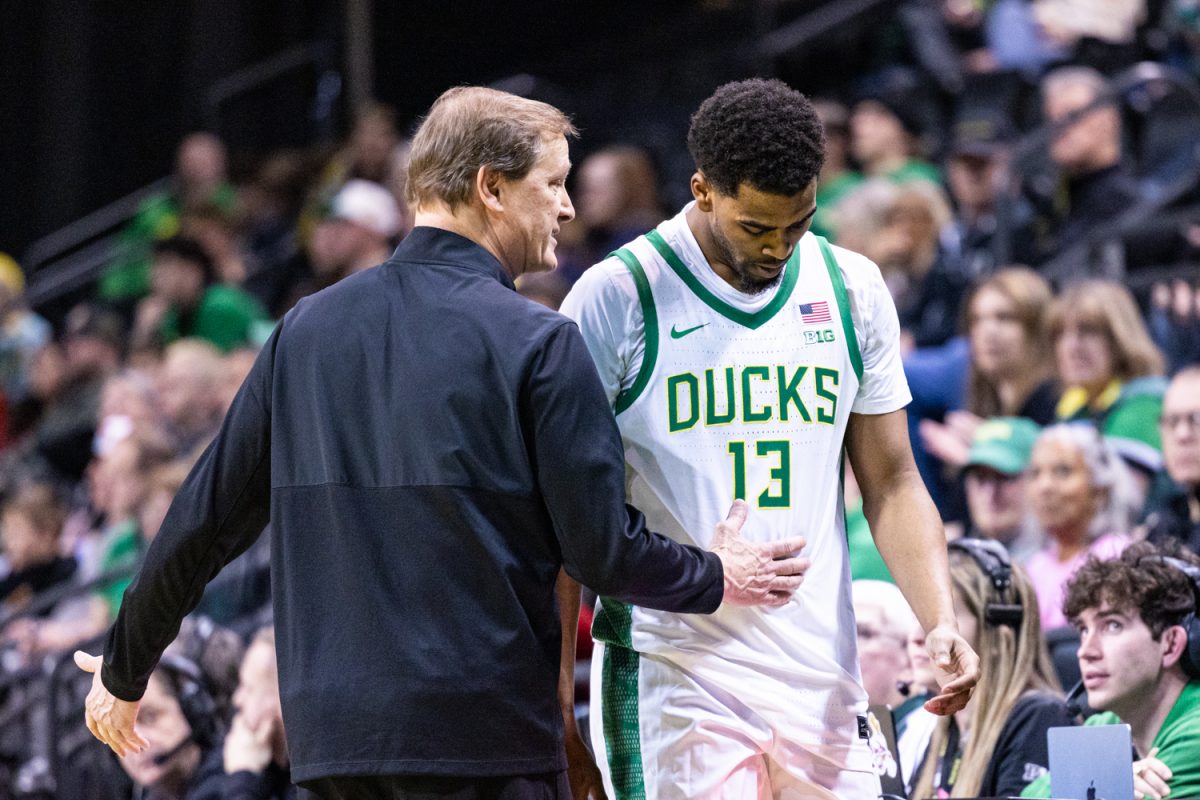
On March 11, Oregon men’s basketball’s (12-20, 5-15 Big Ten) season ended after the 16-seeded Ducks fell to the 17-seeded Maryland Terrapins 70-60 in the first round of the Big Ten Tournament.
The game became a reflection of the season itself, as it became head coach Dana Altman’s first without reaching 20 wins, the least successful of his tenure in Eugene.
Against the Terps, Oregon scored a season-low 12 points in the first half. On top of that, half of those points came from free throws, which meant the Ducks only made three field goals in the opening frame. While a 48-point second half where Oregon did cut the deficit to single-digits late in the game made the final scoreline slightly sweeter, it didn’t reflect Maryland’s overall dominance throughout the contest.
After two consecutive NCAA Tournament appearances and being voted in the AP Top 25 at some point in six of the previous seven seasons, Oregon’s season ended quietly in Chicago.
Why?
The most obvious answer would be the lack of depth. Simply, any team without multiple rotational pieces for long periods of time will find itself in trouble. But Oregon’s issues went a lot deeper than that.
Star point guard Jackson Shelstad never played in 2026, as his Dec. 28 injury in an 80-57 win against the University of Nebraska-Omaha kept him sidelined for the remainder of the season. When he played, he was effective.
Shelstad averaged 15.6 points and 4.9 assists per game in the 12 games he played this season, which was production that the Ducks found irreplaceable almost as soon as they began Big Ten play. In the portion of the campaign after he was shut down, Oregon went 5-14 with 11 of those losses coming by double-digits.
The offense couldn’t score enough to keep track of the gauntlet of Big Ten powerhouses the Ducks faced. Shelstad’s absence was felt in the lack of efficient passing as a team, something he spurs with both his on-ball playmaking and his off-ball movement.
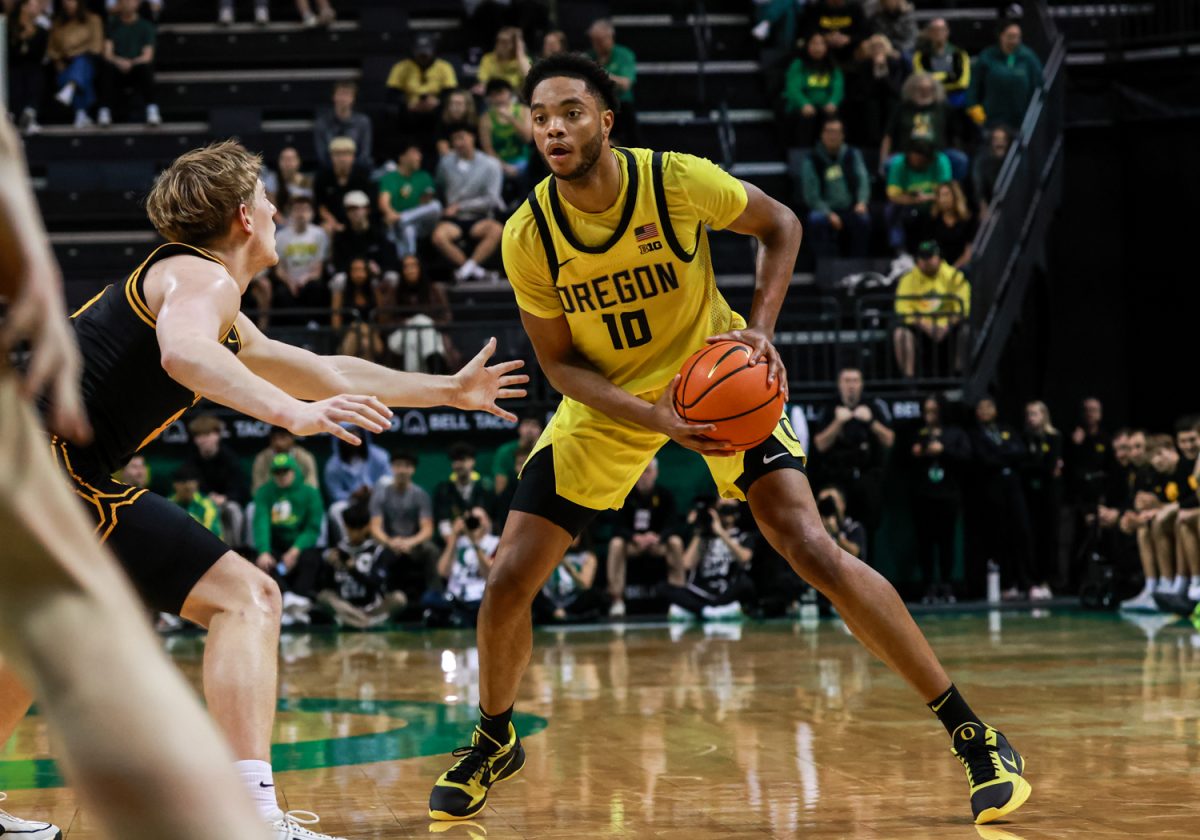
On top of the starting point guard, early-season starting forward Devon Pryor went down with a groin injury, backup center Ege Demir succumbed to a shoulder injury and, most notably, starting center and top scorer Nate Bittle missed time due to an ankle problem that he never fully recovered from.
Without crucial pieces of the frontcourt rotation, Oregon’s defense allowed opponents to control the paint and hit 3-pointers at an effective rate. This season, the Ducks allowed teams to shoot 51% on twos and 33% on threes; not exactly numbers that will have a team still dancing in late March.
The offseason means that players will depart, via transfer portal, graduation or otherwise, and Altman will have to retool his roster, but a season in the basement of the Big Ten can’t be the end of the world for this program. “We’ve gotta get some experience in the portal,” Altman said.
“We’ve gotta get some talented freshmen… and we’ve gotta get a core group back.”



![Oregon outfielder Angel Laya (53) greets outfielder Jax Gimenez (7) before the first pitch. On May 30, 2026, The Oregon Ducks defeated the Washington State Cougars [4-0] in game 4 of the NCAA D1 Baseball Regionals at PK Park, at University of Oregon, based in Eugene, Ore. (Fred Hall/Emerald)](https://dailyemerald.com/wp-content/uploads/2026/05/2026.5.30.EMG_.FJH_.BSBLvsWashingtonStNCAA-1-1200x800.jpg)


![Oregon players celebrate on home plate with infielder Naulivou Lauaki Jr. (18) as he rounds home after his home run. On May 30, 2026, The Oregon Ducks defeated the Washington State Cougars [4-0] in game 4 of the NCAA D1 Baseball Regionals at PK Park, at University of Oregon, based in Eugene, Ore. (Fred Hall/Emerald)](https://dailyemerald.com/wp-content/uploads/2026/05/2026.5.30.EMG_.FJH_.BSBLvsWashingtonStNCAA-13-1-1200x800.jpg)
![Oregon third baseman Drew Smith (17) looks to the mound as he comes up to the plate. On April 24, 2026, The Oregon Ducks defeated the Penn State Nittany Lions [5-4], at PK Park, at University of Oregon, Based in Eugene, Ore. (Fred Hall/Emerald)](https://dailyemerald.com/wp-content/uploads/2026/04/2026.4.24.EMG_.FJH_.BaseballVsPennSt-10-1200x800.jpg)

Steve Scarich • Mar 17, 2026 at 4:58 am
Really inadequate analysis. How about lack of talent? Weak buy-in by players? Lack of ability to recruit to Eugene? NIL gap? Come on, Mr. Reporter, do better. Maybe I am being an alarmist, but this looks like an existential ‘crisis’ for UO hoop.