The only time I experienced tear gas was during an unlucky encounter with a protest in France. The Parisian police had accidentally dropped tear gas canisters into the subway below, leading to everyone in the crowded metro car to be trapped in a haze of chemical gas. The sounds of uncontrollable coughing came from every direction as tears poured down my face. I’ll never forget the intense burning smell and the way it choked me.
This experience doesn’t feel quite so distant anymore as I see similar tactics being used in Eugene today.
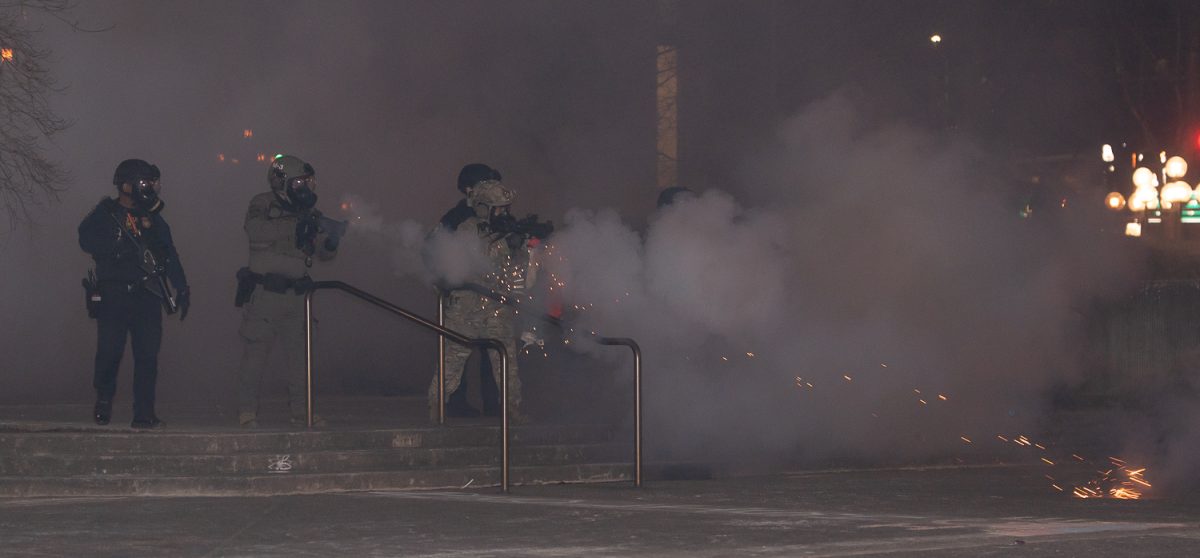
On Jan. 27, pepper balls, flash-bang grenades and tear gas were deployed against protesters over the span of four hours at a protest and vigil located at the Eugene Federal Building.
One protester said they experienced being teargassed that day and again on Jan. 30. They requested to remain anonymous due to fear of retaliation by DHS. The protesters explained that they showed up as part of the weekly interfaith “Singing for our Lives” protest.
“They started firing munitions while we were singing. It was a sudden but unsurprising escalation,” they said. “On Friday, things got quite heated.”
The Jan. 30 protest was deemed a riot, and President Trump even called out EPD on Truth Social for not having stopped the “criminals” from “breaking into” the building and doing “great damage.”
So, what was the damage? Video showed a federal agent who smashed a window from the inside to shoot tear gas out at the crowd.
“People are feeling scared but more empowered,” the protester said. “It’s very clear that (DHS) wanted to escalate, and they wanted any excuse to use this force.”
According to the Geneva Protocol of 1925, the use of chemical weapons such as tear gas is illegal in warfare, yet they are being utilized by the U.S. government against protesters regularly.
Dr. Stephanie Wiley is a UO sociology professor with 20 years of experience in the criminology field. “This wouldn’t be the first time the U.S. and international standards are at odds. Our entire criminal and juvenile justice systems are out of step with the United Nations’ recommendations for protecting human rights,” she said.
Wiley explained that the use of tear gas at protests does not de-escalate conflict and has the possibility of making situations worse. “Despite the potential for strengthening social connections within the protest group, the negative consequences of using tear gas certainly outweigh any
benefits,” she said.
“Chemical sprays, like tear gas, are the last step before lethal force. I don’t believe tear gas should be used at peaceful protests, and I think there are better methods for handling large crowds when disorder and illegal activity erupt,” Wiley said.
Protesters haven’t been the only ones targeted by munitions and violence by federal agents. The Daily Emerald captured video that shows agents continuously shooting at press who clearly and repeatedly identified themselves.
While the First Amendment guarantees freedom of the press, it apparently does not guarantee that journalists will not be targeted and attacked by their own government.
A federal judge temporarily prohibited DHS from using crowd control munitions at Portland’s ICE facility after tear gas was deployed on a peaceful protest, harming protesters, children, pets and elderly people.
My question is, what will it take for that temporary order to become permanent and extend to other communities facing similar treatment? Largely unidentified, masked federal agents are controlling what they deem to be “crime” at the cost of our community’s safety and freedom.
We’re at the point where Eugene City Council has declared a humanitarian crisis, yet residents are left to deal with the consequences and fear of being tear-gassed for standing up.