Eugene’s city council voted 4-3, broken by Mayor Kaarin Knudson, to implement the Technical Advisory Group on Fiscal Stability’s economic development recommendations, which include adding four new city positions.
The advisory group was formed after a council vote in July 2025 moved to create an ad hoc committee that would serve as a financial advisory panel to guide the council through the city’s budget crisis. The group began working in September, and delivered a final report with recommendations in February.
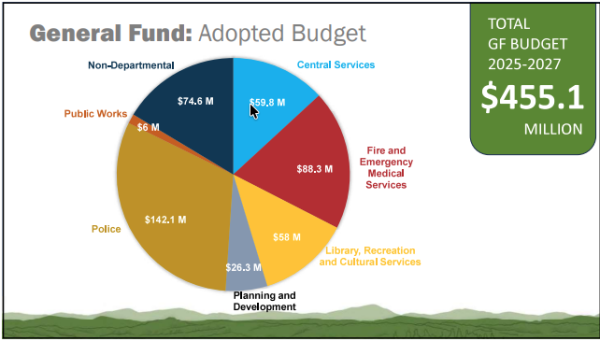
The city has struggled with long and short term financial challenges for years, with its biggest issue being a structural deficit of the general fund. For the 2025-27 budget, the city has $445.1 million, which is the primary source of funding for public safety, recreation, cultural services and more. Currently, public safety takes up the largest amount of the general fund budget, using $143.3 million. Property taxes are 64% of the fund’s source of revenue.
The top three areas that the group recommended the city focus on are operational efficiencies, revenues and economic development. The group found that the city has gotten lucky with the little growth it’s had, despite not having “prioritized a cohesive or coherent economic development strategy that can grow the tax base and support a flourishing community.”
While researching data on Eugene’s current economic development, TAG found that compared to other cities, Eugene’s employment grew 33% between 1991-2024. The median household income for householders is the lowest among compared cities at $70,781.
“Eugene’s households have jobs that pay less than their peers in these other cities,” Anne Fifield, the city’s economic development section manager, said during the work session. “One reason we have lower income is because there’s fewer economic opportunities, it’s harder to move up to a better job.”
Using the recommendations provided, TAG believes the city would generate 14,000 new jobs and gain $25 million in tax revenue within the next 10 years.
The group’s general recommendations focus on supporting and reinvesting in existing small businesses, encouraging new businesses with loans from the city, working on proactive recruitment from outside the city and collaborating with regional partners.
The Southern Willamette Valley Innovation Corridor is one of the city’s biggest partnerships regionally, working with the University of Oregon and Oregon State University to create connections between the schools and science and technology industries to foster research investment.
“With engaged private and public partners, it has the opportunity to obtain the next generation of talent coming out of our educational institutions,” Will Dowdy, community development director, said. “Already our city manager is engaged in high level regional conversations, Anne and I are talking with partners. But unless it’s time to start talking to individual businesses, we lack the ability to develop and implement an action plan.”
Currently, the city has two jobs that mainly focus on economic development: the business liaison and the business loans analyst. To expand the city’s area of focus, TAG recommended three new positions be added to focus on project management, program development and implementation.
The proposed business development manager would be the primary lead for the implementation of economic development and TAG’s recommendations. The business development analyst would bring support to prioritized strategies and programs. The housing production analyst would help increase the housing supply outside of existing affordable housing efforts, to support the working population. All three of the positions would be funded by the general fund.
One other existing position, the development liaison, is currently vacant but would be self-funded by Building Permit Services. This job would be relaunched and bring support to permit applicants and improve communication between the city and businesses.
“Because of the long range financial planning, these positions now make sense,” Dowdy said. “We have a clear understanding why they are needed, what they need to accomplish, how they can connect to the work of our partners, how we can measure success, and how the investment pays off in increased tax revenue and prosperity.”
The total cost of funding the four positions would be $800,000 a year from the general fund. However, TAG expects $10 million in new taxes by year 10 of implementation, meaning a 1150% return on investment.
The city council appeared to be split on voting for a motion to direct the city manager to begin implementing TAG’s recommendations, including the proposed positions.
“I am supportive of these positions, and this work is highly needed to be able to meet our goals, I just am not ready to designate this level of funding, without having that information at hand first. So that’s just where I’m sitting right now. But I love this work,” Ward 7 Councilor Lyndsie Leech said.
“It’s my opinion that this is the only way for us to move forward in a healthy fashion. That’s it,” Ward 5 Councilor Mike Clark said. “We have no hope in my opinion of getting ourselves off the road to bankruptcy, unless we have a very clear plan about how we will grow our local economy. So it sounds like a good first step. I’m in favor of starting, but I want to have a lot more conversations about this, in a similar way.”
Other councilors similarly voiced that they were in favor of the recommendations, but felt that the timing of the implementation was too early, and more conversations would have to be had about how the $800,000 would be taken out from the general funds.
Councilors Yeh, Groves and Clark voted in favor to pass the motion, and Councilors Leech, Kashinsky and Keating against. Ward 3 Councilor Alan Zelenka and Ward 6 Councilor Greg Evans weren’t present to participate in the vote. Mayor Knudson broke the tie by voting in favor of passing the motion.
Editor’s note: This article has been corrected on the number of positions that will be funded by the city, monetary amounts in the general budget and the ward of some councilors. The Emerald regrets this error.