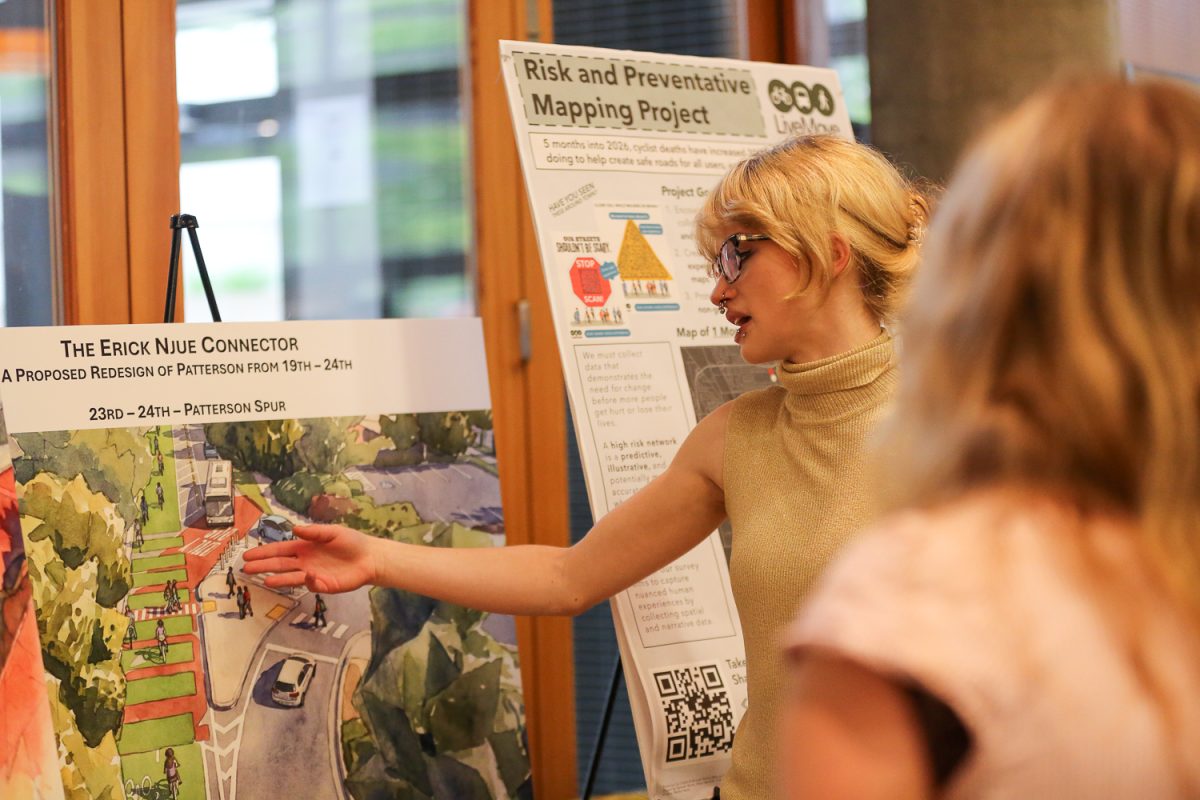
May 1 is International Workers’ Day, celebrating the labor movement that won workers their rights in the late 1800s. At the University of Oregon, students and faculty celebrated May Day with a rally in front of Johnson Hall, organized by UO Anti-ICE Coalition and UO Latinx Coalition.
At 2:30 p.m., around 100 people joined together on the lawn across from Johnson Hall, some students walking out of their classes. By 3 p.m., the crowd had grown to around 200 attendees.
Jacob Leinwand, a member of the Anti-ICE coalition, said, “There are mass protests going on all around the world right now in honor of labor rights. This one in particular is to demand that the UO administration listens to the Latinx Coalition and the Anti-ICE Coalition.”
Leinwand said the goals of the rally were the same goals the Anti-ICE coalition has had since its inception: to get the university to commit to building a brick-and-mortar Latine Cultural Center, to pledge against using the student code of conduct against students or faculty who obstruct ICE activity on campus and to defend students and faculty in legal battles against the Department of Homeland Security.
While another one of their previous goals was fulfilled recently — getting the university to initiate a comprehensive notification system for ICE activity on campus — some representatives said there’s still work to be done.
Leinwand said that while the notification system being put in place is a step in the right direction, the university originally lobbied against the Oregon bill that mandated it.
“Educational institutions have an obligation to protect their students. They are here to serve and protect us; they are employees of us. We pay their salaries, and they lobby against protecting us,” Leinwand said. “Institutions that pretend to hold up the idea of progress should actually commit to protecting their students, especially the ones that are under threat from DHS and ICE.”
Prissila Moreno, the president of ASUO, said the university would’ve done the bare minimum to comply with the Oregon legislation if it weren’t for the Anti-ICE coalition’s pressure.
“This university only responds to things if it is a mandate,” Moreno said. “It wasn’t until the Anti-ICE coalition showed up in numbers here at Johnson Hall and delivered a letter with over 2,000 signatures from students that they suddenly had the capacity and capability to put together a plan expeditiously.”
One speaker at the rally, Anti-Ice Coalition and YDSA Representative Isaak Ordaz, said the university needs to allow for more student input in the ICE notification system..
“The fact that they are committing to utilizing the existing alert system for notifying students about ICE is great, but we do have to realize that it happened because of the struggle of students. It happened because there was pressure exerted on them,” Ordaz said.
According to Ordaz, the university was originally going to wait five to six months before implementing the system. “It is a testament to the power that we hold when we get the masses moving,” he said. “When the workers and the students are moving, you can force those in power to realize that they aren’t the biggest fish in the pond.”
However, Ordaz said he wishes there were more opportunities for student input.
“We need a democratic university. We’re having our democracy attacked every single day, and they’ve been trying to do their best to take it away from us as students on the campus as well for the last 15, 20, 30 years. It’s high time that the administration takes a step back and realizes that it should talk to its students,” Ordaz said.
Another major issue discussed at the rally was the building of a Latine Cultural Center on campus. A speaker at the rally was Giovanni Bazan-Espain, who is president of the Latino Male Alliance, the racial justice coordinator at the multicultural center and senator-elect for ASUO’s Senate seat 8.
Bazan-Espain said he was embarrassed to see only two stand-alone cultural centers at UO in comparison to visiting Oregon State University, which had seven.
“Why doesn’t President Scholz want this? Why? If the Latinx Culture Center cost $0, would he implement it?” Bazan-Espain said. “I 100% am confident in my mind that he would say no.”
Jenny Yoder, a rank-and-file member of YDSA, said the Latino Students Coalition has been trying to meet with the administration for a while, and “keep getting shot down or, frankly, laughed at in the meetings that they are able to get. They deserve the Latine Culture Center that they’re fighting for.”
Yoder said the university hasn’t done enough to support its students.
“We work hard to be here, and we deserve their protection and their support,” Yoder said. “We want them to actually take us seriously. We want them to see that we are a force on this campus and that we have the student body behind us.”
Vice President of the Persian Student Union Ava Momtazi was present at a table near the rally to support the community.
“We as minorities; we know the struggle. I think it’s really important to support one another,” Momtazi said. She said the importance of a Latine Cultural Center is important.
“It’s really important for everyone to have a place to fit in,” Momtazi said. “I mean, I’ve met so many students of color that leave the University of Oregon because they feel like there really isn’t much of a space for them.”
Students also gathered to celebrate May Day and its importance to labor unions.
“I grew up in farm work,” Bazan-Espain said. “I’ve been working in farms since I was 12, 13 years old in Hermiston, Oregon.” He said he loved to see the union representatives speak at the rally to celebrate the day. “It’s phenomenal to see how we all come together, bring our issues together, and all help each other simultaneously.”
Michael Dreiling, a professor of sociology at UO for 30 years, said the intersection between migrant rights and labor rights is bigger than we might think. The rights granted to workers in the late 19th century were not granted to everybody, according to Dreiling.
“Farm workers, household servants, mostly undocumented workers are excluded from labor protections,” Dreiling said. “Everybody needs to enjoy the protections of minimum wage, labor protections, the right to unionize, the right to collective bargaining. Those aren’t extended to workers who are predominantly immigrant or undocumented, who are in the fields and now threatened and terrorized by ICE.”
Dreiling said that as a sociologist, he’s watched what’s happening in America with “great alarm and concern,” but that he is inspired by the students who were rallying outside of Johnson Hall.
“I’m so moved with hope, and I hope that other students are paying attention, that youth are paying attention,” he said. “The way that students and young people today are going to be able to craft a future that’s sustainable, healthy and equitable is by getting engaged in this kind of work and becoming forces for human rights, for democracy, for equality.”
Midway through the rally, the group marched around Johnson Hall, completely encircling the building.
After the rally had concluded, the group split up into small groups and conducted “teach-ins” to educate students on university protest history, demonstration safety, union involvement information and the history of immigration oppression in other cultures.
“We called for a walkout disrupting the flow of the university,” Ordaz said. “But just because we aren’t doing the learning where the university expects us to doesn’t mean we can’t do learning at all.”
On May 6, UO Latinx Coalition will be holding another rally in front of the Erb Memorial Union.