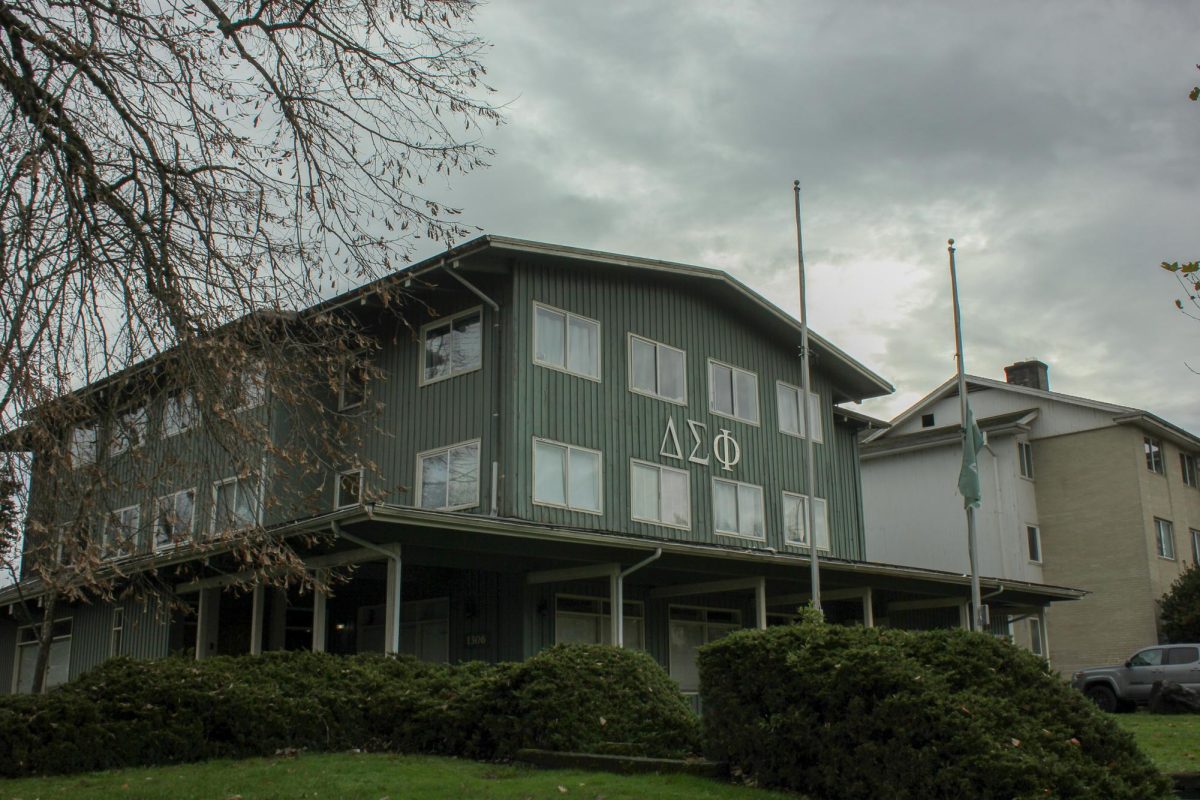
The University of Oregon Police Department is currently investigating the fraternity Delta Sigma Phi for hazing allegations. It joins Kappa Kappa Gamma, a sorority, as a Greek life organization under interim suspension.
On Nov. 1, UOPD received a report in response to hazing allegations at Delta Sigma Phi, followed by a report on Nov. 2 to the Dean of Students office.
Once a report is submitted, the Dean of Students office determines if enough information is available to continue the investigation and “spend a few days corresponding with potential witnesses associated with a report,” Dianne Tanjuaquio, senior associate director of student conduct, said.
Kappa Kappa Gamma, a sorority, also faces interim action. UOPD is not part of the investigation into KKG. In both cases, the Dean of Students found there to be enough information to proceed with an investigation and issue interim action to both KKG and DSIG on Oct. 27 and Nov. 7, respectively.
In accordance with the Student Conduct Code, interim action is reserved to “address a substantial and immediate threat of harm to persons or property.” Both organizations are currently under temporary suspension from new member activities, group communication, and events and programming, as seen on the Dean of Students webpage.
According to UOPD Police Chief Jason Wade, there is no set timeline for both the police or the university’s investigations. They can range from weeks to months.
Hazing is defined by physical brutality or unreasonable risk of harm, including the consumption of substances that could affect the person’s health.
RealResponse, a private reporting service for members of greek life released in February, allows students to report hazing anonymously.
Jimmy Howard, associate vice president of student life and dean of students, attributes the increase of drink, drug tampering and hazing reports, in part, to RealResponse.
Once a report is submitted, the extent of law enforcement involvement is somewhat dependent on the wishes of the student who reported the incident. Many “may not want a criminal investigation if one is afforded to them,” Howard said.
UOPD is directly involved in the DSIG investigation due to having been specifically contacted by an affected student.
Following interim action, the Greek organization’s national headquarters is contacted, followed by an interim action appeal meeting and a formal Notice of Allegations is issued to both KKG and DSIG. KKG appealed the interim action to no avail.
A Notice of Allegations includes a description of the alleged misconduct, the specific violation of the Student Conduct Code, assignment to a case manager and a date and time for the informational meeting in which a student organization representative — oftentimes the president — can informally review the report.
At the informational meeting, a time is set for the Administrative Conference. In this meeting between the case manager and student organization representative, the student organization can formally respond to the allegations.
Witnesses can be provided to the case manager ahead of the conference and are interviewed but cannot be forced to answer specific questions.
Organizations are not required to participate in the process, Howard said. “We hope that they participate and move forward with us in a transparent and honest way.”
Preceding an administrative conference, the case manager may conduct additional investigations or make a final decision.
UOPD conducts the investigation in a “more independent version” than the Dean of Students, Wade said.
Witnesses may be referred to Student Life after speaking with UOPD, or vice versa.
Neither investigative party wants to “step on each other’s toes,” Wade said, which
might ultimately harm each other’s investigations.
UOPD and the Office of the Dean of Students have varied amounts of evidence needed to charge a student organization or member with a violation.
“(UOPD has) have to have probable cause to make an arrest or charge,” Wade said.
Additionally, UOPD has to consider if there is substantial evidence to reach a conviction in court — that the suspect, beyond a reasonable doubt, committed a crime.
The Office of the Dean of Students instead reaches a conclusion on whether DSIG or KKG violated the Student Conduct Code based on a preponderance of the evidence — “it’s a lesser version of what we’re trying to do,” Wade said.
“There’s a lot of complexity to these cases, you know, especially with the hazing instance, you have, you know, people who are at the at the fraternity, who are, you know, protective of it,” Wade said. “Now, I have my own personal beliefs that probably happens more often than not.”
Wade said that it is rare there is actually a report made to UOPD, but despite this, he believes it is prevalent in many forms on campus.
If KKG or DSIG is found to be in violation of hazing policies, an action will be issued which outlines potential consequences ranging in severity from a conduct warning, probation or suspension.
As KKG and DSIG are both affiliated student organizations, suspension means losing university recognition.
“Suspension is reserved for more serious matters, and hazing could be one of those,” Howard said.