
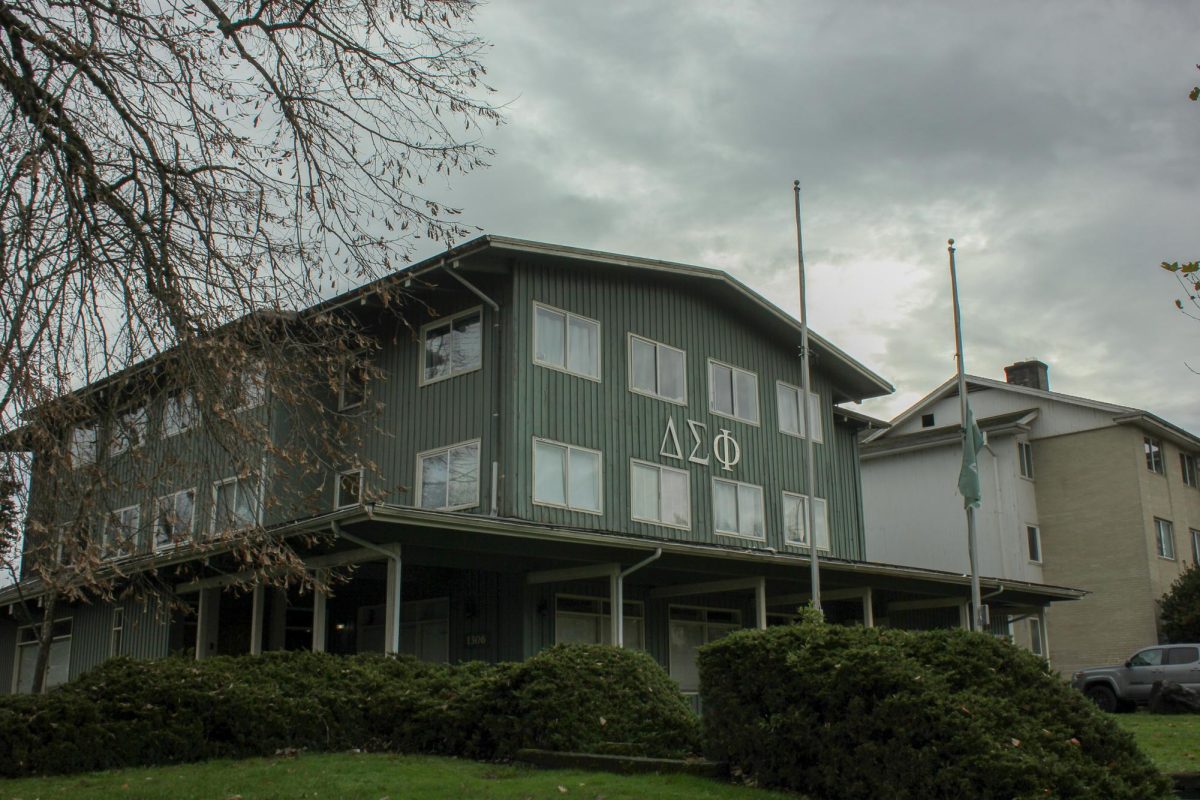
Two affiliated Greek organizations are currently on temporary suspension of new member activities, including Kappa Kappa Gamma and Delta Sigma Phi. Alpha Tau Omega and Sigma Chi were recently lifted from suspension.
On Dec. 4, 2025, both ATO and Sig Chi were issued a suspension for “reported conduct that may violate the Student Conduct Code and raised immediate health or safety concerns,” Kristina Cammarano, University of Oregon associate vice president for experiential learning said.
According to Cammarano, hazing investigations at Kappa and D Sig will come to a conclusion in the next few weeks.
Following a series of hazing, drink and drug tampering reports and organizational violations, Fraternity and Sorority Life devised a winter plan which included a three-week hiatus, from Jan. 3-24, putting a pause on all social events with alcohol.
During the break, the Interfraternity Council and the UO Panhellenic Council members were assigned online training modules. The required curriculum addresses sober monitoring, safe partying, hazing and sexual assault prevention.
Both IFC and PHC answer to their respective national organizations: the National Panhellenic Conference and the North American Interfraternity Conference. Currently, IFC houses 16 fraternity chapters, and PHC has 11 sorority chapters. In the event of a breach in student conduct, the national organizations are notified.
Along with a hiatus, the “FSL Community Care & Safety Response Winter 2026” plan outlines new initiatives to create safer environments. The more notable changes are as follows: improved prevention curriculum, more accountability structures, enhanced transparency on the hazing website, new safe partying guidelines and increased FSL support.
“We have a really strong relationship that we’ve built with our students and our student leaders. There are so many great positive things that come from affiliation. We want to continue to support and uplift that interest in maintaining affiliation,” Cammarano said.
Affiliation recognition
As defined by FSL, a recognized organization is one that is “in good standing with the university.” Additionally, an affiliated fraternity has associated privileges which include “using university facilities and equipment, holding meetings and programs on campus, recruiting new members that will be recognized by the university and participating in university-sponsored activities.”
Recruiting at a high level is crucial to effectively fund the sorority or fraternity chapter. Delta Gamma Treasurer Beatrice Gilroy said that the support from FSL and PHC during formal and informal recruitment is the biggest privilege to affiliation.
Despite no direct funding from the university, all members pay new or active member dues each quarter. New member dues vary at each Greek organization, ranging $125-$1300 for new members and $2500-$3200 for active members (room and board), according to the FSL website.
Jimmy Howard, associate vice president of student life and dean of students, underscores the recruitment risk at unaffiliated organizations: “The livelihood of those organizations just continue to go down because they’re not able to recruit at the same level of other organizations that are a part of the official university process.”
Cammarano attributes the lack of recognition as the biggest risk at disaffiliated fraternities.
Disaffiliation pitfalls
Disaffiliation, as defined by Cammarano, occurs when “a national organization decides that their local chapter will operate independently of the university.” Unrecognized organizations are unable to engage in FSL community support, services or activities. It is increasingly rare for recognized organizations to willingly opt for the disaffiliated model. More often than not, disaffiliation begins with a refusal to comply with the parameters of a suspension.
Howard specifies, “those sanctions are intended to pause and get things in order. And so a lot of times, those groups don’t want to serve that time of being suspended and not recruiting.”
Another key distinction between affiliated and disaffiliated organizations is police jurisdiction.
According to the non-finalized “UOPD Patrol District” memorandum of understanding with the City of Eugene, UOPD will be “the primary police response for all fraternity and sorority houses,” UOPD Chief Jason Wade said.
Conversely, reports at unaffiliated houses are referred to the Eugene Police Department. “We (UOPD) would handle it just like an apartment building or some other structure outside of our jurisdiction,” Wade said.
When asked about whether or not students should attend parties at disaffiliated fraternities, Wade simply said, “Don’t.”
“If I’m going to a bar, for example, I’m not going to go to someone who’s selling alcohol out of the back of a van. I’d take the registered license location,” Wade said.
For UO Alerts, if an incident happened at an unaffiliated location, or a live-out, for example, only the address would be noted, “because we don’t have an official designation for them,” Angela Seydel, UO spokesperson said.
Following a report at an unaffiliated fraternity, the subsequent university investigation varies from one at a recognized chapter. In a disaffiliated model, investigations focus on the individuals connected to the alleged incident. For instance, police may find leaseholders or unaffiliated leaders accountable, but the fraternity itself is not subject to investigation.
“If it’s a disaffiliated group and something happens, we’re still going to take it very seriously. It’s just a matter of who is responsible,” Howard said. Due to the inherent lack of a relationship between unrecognized fraternities and the university, Howard added that there may be fewer points of contact for disaffiliated organizations. Affiliated organizations are not necessarily more protected, but they do have a greater support system.
Both Howard and Cammarano see great risk in the disaffiliated model found at the University of Southern California and the University of Michigan. Due to the increased liability, pressure on student leaders and lessened membership, the model is rarely actualized.
“By and large, the unaffiliated tends to not be very successful because you have to set up a whole new infrastructure for it to work. You’re hiring all new staffing. You’re setting up a 501(c)(3), a whole new banking structure, insurance (and) recruitment to make it work.” Cammarano said.
Cammarano pointed to a recent example, in which previously unaffiliated organizations Alpha Sigma Phi and Sigma Alpha Epsilon agreed to comply with the terms of their suspensions, paving a path back toward campus recognition.
Editor’s note: This article has been edited to reflect that ATO and Sigma Chi are no longer on suspension.



SM • Feb 5, 2026 at 4:56 pm
Why choose 1 fraternity as the feature image vs all the ones called out in the article. You know people skim and focus in on pics and make assumptions from that alone. Unfair reporting imo.