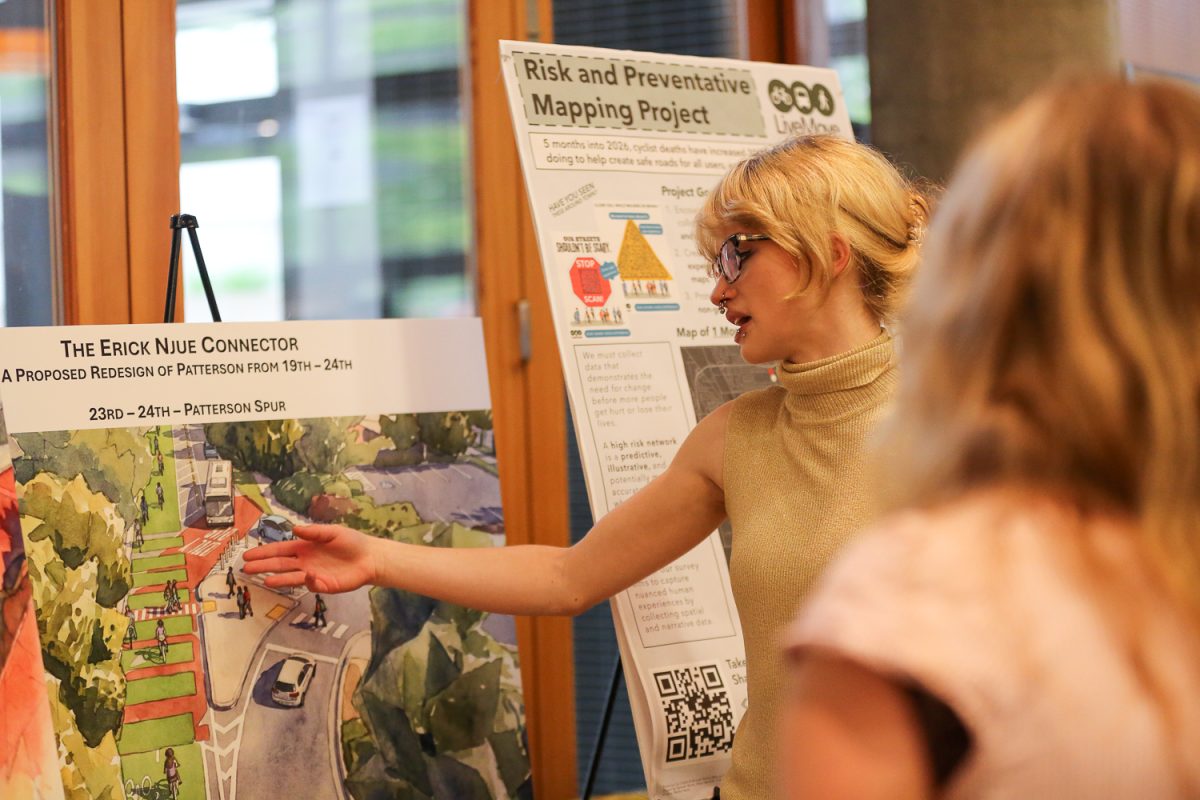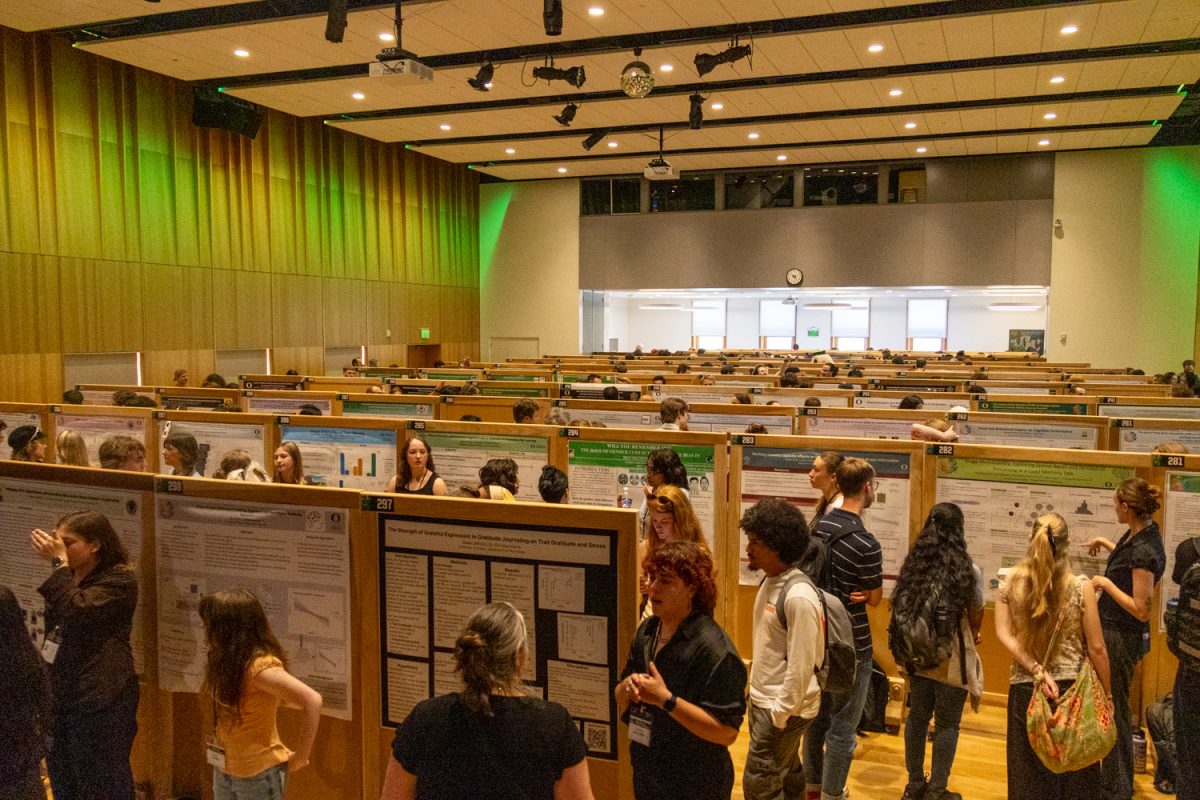
The University of Oregon hosted its 16th annual Undergraduate Research Symposium on May 7 reaching a record number of participants with just under 600 student presenters.
Student research spanned all eight UO departments, as well as the Ballmer Institute for Children’s Behavioral Health and the Phil and Penny Knight Campus for Accelerating Scientific Impact.
Presentation times were broken up throughout the day, in which students had the opportunity to stand by their poster and discuss their research, read or screen creative work or do an oral presentation. Keynote speaker for the event and alumna Mérida Mehaffey, class of 2018, spoke about how her undergraduate research has prepared her for a professional setting.
Lily Rice, a junior marine biology student, researched how cranial bones and sensory organs interact in fish by examining how the neuromass of three-spined stickleback fish shapes their cranial skeleton.
Rice said that during the experiments the fish swam in two different types of dye, which allowed her to see their skeletons and neuromass. She then analyzed the fish under a microscope and conducted data image analysis.
“I wanted to see how the neural masks were being added, and also the rate they’re being added. So our main finding with that was that the neuromass being added at a relatively steady rate in these regions, as the fish grows,” Rice said.
Preparation for Rice’s research began over the summer, but she just completed the data image analysis graphs last week. Rice said she logged over 100 hours alone on counting the neuromass of the fish seen in the microscope.
“My whole year has been working on this,” Rice said.
Rice said she hopes to continue this research with a grant in the future, which would allow her to dissect the neuromass and bone tissue to examine gene expression.
Rice encouraged students to get involved in undergraduate research, including looking for lab opportunities.
“I’m (majoring in) marine biology and this is very developmental biology. So when I got into this, I was like, ‘oh, I’m not sure if it’s what I want to do,’ but then I really ended up loving it. So I think it’s good to just get into it and try it,” Rice said.
Freshman Coretta Foster researched the economic impacts of African neocolonialism in former French colonies.
Foster, who conducted literary and data analysis, became interested in the topic after taking an intro to African studies class during fall term.
“The final assignment was to summarize a research paper. The one that I selected discussed African Neocolonialism which made me interested in the subject,” Foster said. “When the question of conducting further research on a global topic came up, it came to mind.”
Foster said the symposium is “good exposure to the research process” and gives students the opportunity to explore their interests.
Foster said that if she was to continue her research, she would want to conduct fieldwork through in-person interviews and data collection.
Sophomore Diego Escobedo worked at a lab through the Knight Campus, researching a disease in the eye called Retinitis pigmentosa, which causes blindness as photoreceptors in the retina break down.
Escobedo conducted multiple experiments, including labeling and isolating cells.
“There have been treatments that have successfully repaired the first layer (which is killed by the disease), but this disease causes downstream effects on these entrances,” Escobedo said. “So basically it’s like a bridge burns down and you try to rebuild it from one side. You can’t cross the bridge. So basically, they’ve built one side, we’re trying to repair this other side.”
Escobedo said he plans to use this research as part of a thesis and thinks the symposium is a great place to build presenting skills.
Since its debut in 2011, the symposium has represented 5,249 student presenters and 3,084 from over 90 majors. This year, 597 student presenters marked the highest number of participants, around 70 more than 2025’s symposium.