The 48th annual Take Back the Night rally was held April 30 by the University of Oregon Women’s Center. This year’s theme, “collective power,” focused on “a reflection of strength that shines when people come together.”
According to Women’s Center Program Director Sarah Doty, this year’s theme “rejects isolation and emphasizes that no one has to resist or recover alone.”
“Students, staff, faculty and community members come together with various levels of knowledge and understanding regarding sexual and domestic violence, and we want them to learn from and witness survivors sharing their stories,” Doty said. “We also want this rally to be a call to action and ask individuals to consider what they can do in their spheres of influence to help prevent future harm.”
In line with the theme, this year’s rally focused on awareness and action.
“We are here tonight, and every year on the last Thursday in April, because using our voices collectively can create change in our community. Because there are so many of us who carry stories we were never supposed to carry. Because sexual, domestic and dating violence are not isolated experiences, but patterns, systems and realities that we need to confront together,” Women’s Center Sexual Violence Prevention and Education Coordinator Lola Sponaas said.
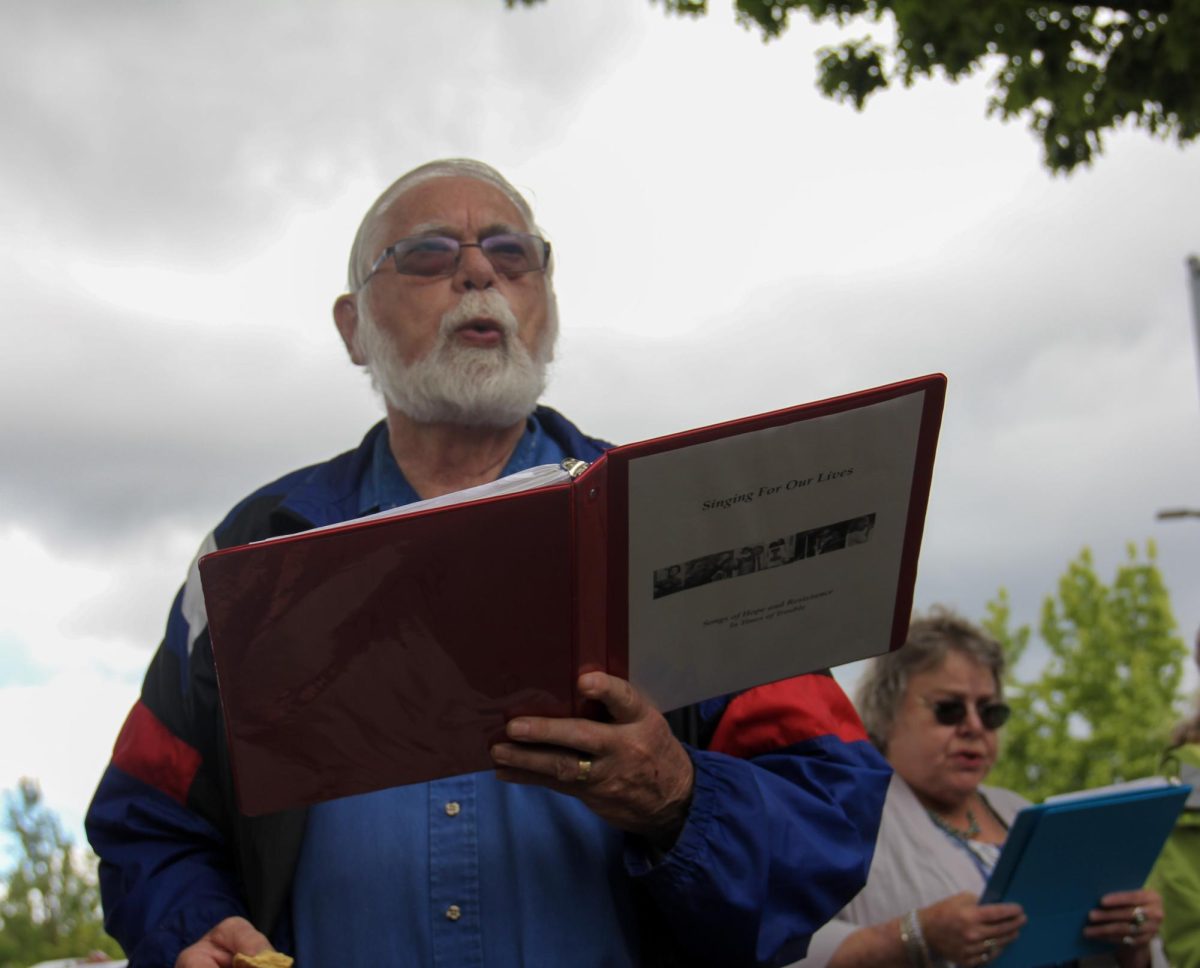
The event began with a rally from 6 to 7 p.m., featuring several UO student speakers and a keynote address by Libra Ford. Participants then marched through campus and Eugene streets until 8 p.m. After the march, UO students and select confidential staff held a speakout from 8 to 9:30 p.m. in the EMU Cedar and Spruce rooms.
“Awareness is not enough. We need action, accountability and each other. And every time we speak up, we are shifting the culture,” Sponaas said. “Every time we believe someone, we make it safer for the next person to come forward. Every time we refuse silence, we challenge the systems that depend on it to survive. That is collective power.”
The rally featured several UO student speakers who shared personal experiences with sexual assault and domestic violence.
“I am living proof that not only can you overcome a devastating experience like abuse, but you can also make it out alive and kick ass too,” speaker Kelly Barber said.
Representatives from the Indigenous Women and Marginalized Genders Wellness Group also participated, speaking about violence against Native women. Members Christina Thomas and Kiki performed a traditional jingle dance, described as “a form of powwow dance first brought into the world by the Ojibwe people, seen as a dance of healing.”
“We as communities and individuals reserve the right to grieve, but we also need to accept our modern world as a place not made for us or by us,” Thomas, a member of the Confederated Tribes of Warm Springs, said. “We share these dances with you as a reminder that the first peoples of this nation are still here.”
Thomas said that, according to the National Congress of the American Indian, Native women have more than an 80% chance of experiencing violence in their lifetime.
“These statistics are not arbitrary numbers, but rather the reality we have to live every single day,” Thomas said. “These statistics are our sisters, mothers, grandmothers and ourselves.”
Representatives of the Muxeres Student Organization also spoke, painting half of their faces as skulls to “represent those (they) have lost to sexual assault and violence against women.” The other half remained bare as a “symbol of vulnerability, new beginnings and hope for the future.”
“Stories like this have changed me, but they cannot control or limit me. I now have the strength to protect and advocate for myself in ways my younger self needed when encountering harm,” Muxeres representative Jasmin Pierra said. “I wish we lived in a world where we didn’t have to be afraid of putting ourselves in situations that harm us. Yet we are often seen as targets.”
Libra Ford, executive director of the Women’s Foundation of Oregon, concluded the rally as keynote speaker.
“It’s a very interesting time in our world where so many of us don’t feel safe, and today is a beautiful moment where speakers have had the space and the time to feel safe enough to share their words and experiences,” Ford said.